
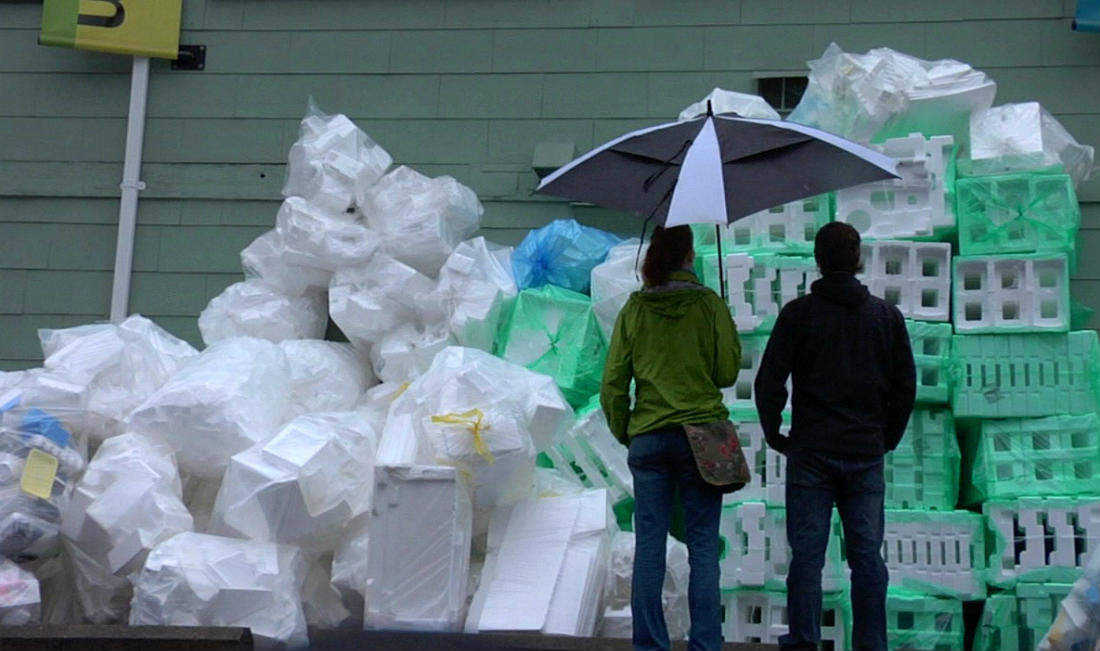
Styrofoam, technically known as expanded polystyrene (EPS), is a widely used material, but it raises many questions about its disposal and recycling. Although it is 100% recyclable, few Brazilians are aware of this, which worsens the environmental impact of this material on the environment. In this article, we will explore the importance of recycling Styrofoam, its challenges, and the initiatives that are making a difference in some regions of Brazil.

Viability and Importance
Despite being a lightweight material, Styrofoam takes up a large volume, which makes transportation and recycling economically challenging. However, polystyrene is fully recyclable and can be transformed into a variety of products, from frames to construction materials.
In Curitiba, for example, a partnership between several institutions has created a recycling machine that can process 300 tons of Styrofoam per month, saving around 5,000 trees by replacing wood in certain products. This machine, installed in Campo Magro, demonstrates how recycling Styrofoam can be viable and beneficial to the environment.
In addition to helping preserve natural resources, recycling Styrofoam prevents this resistant, non-biodegradable material from accumulating in landfills, where it can remain for hundreds of years. By recycling Styrofoam, we are promoting sustainability and reducing the environmental impact of this material, which, if disposed of incorrectly, can cause serious damage to the environment.
Awareness and Education Initiatives
Raising awareness about the importance of recycling Styrofoam is essential for more people to adopt sustainable practices. In Curitiba, the company Meiwa, in partnership with other organizations, has developed educational projects that seek to raise awareness among the population about the proper disposal of this material.
The “Recyclable Planet” project, for example, aims to educate teachers and students about environmental issues and the importance of recycling. These initiatives are essential for more people to understand that Styrofoam is a recyclable plastic and that its proper disposal can make a difference in preserving the environment.
In addition to schools, awareness is also being raised in communities, where around 200 families in Curitiba are already involved in recycling Styrofoam. These families sell the recycled material to Santa Luzia, a company responsible for transforming polystyrene into new products. This recycling cycle not only contributes to the environment, but also generates income for the families involved, showing how recycling can have a positive social impact.

Challenges in Styrofoam Recycling
One of the biggest challenges in recycling Styrofoam is transportation, due to its low density. Although it is a lightweight material, Styrofoam takes up a lot of space, which makes it difficult to collect and transport to recycling plants. The machine installed in Campo Magro was designed to solve this problem by compacting the Styrofoam and removing the pentane gas present in its composition, facilitating the transportation and processing of the material.
Aside from Curitiba and São Paulo, few cities in Brazil have adequate infrastructure for recycling Styrofoam. According to data from the Plastivida Instituto Sócio-Ambiental dos Plásticos, in 2008, only 8.4% of the polystyrene produced in Brazil was recycled. This number is alarming and highlights the need for more investment in infrastructure and public policies that encourage Styrofoam recycling throughout the country.
The Different Ways of Recycling Polystyrene
Styrofoam can be recycled in three main ways: mechanical, energy and chemical recycling. In mechanical recycling, Styrofoam is transformed into raw material for the production of new products, such as moldings, moldings and skirting boards. Energy recycling, in turn, takes advantage of the high calorific value of polystyrene to recover energy, while chemical recycling transforms the material into oils and gases, which can be used in other industries.
The use of recycled Styrofoam is not limited to the manufacture of new products. It has also been used in the thermal insulation of buildings, and when burned in thermal power plants to generate energy, it turns into carbon dioxide and water vapor, without emitting harmful substances into the environment. This makes Styrofoam a versatile material, which, when correctly recycled, can have many uses and contribute to the circular economy.
Successful Examples of Styrofoam Recycling
Styrofoam recycling in Curitiba is an example of how cooperation between companies, government and the community can generate positive results. In addition to the Campo Magro plant, another recycling machine was installed in the Piraquara prison, where inmates process around 4.5 tons of Styrofoam per month.
This initiative, part of the Revima Project – Revaluing Lives and the Environment, not only helps to reduce the environmental impact of Styrofoam, but also offers an opportunity for resocialization for inmates.
These examples show that, with the right support, it is possible to overcome the challenges of recycling Styrofoam and transform this problematic material into an opportunity for sustainable development. Expanding these initiatives to other regions of Brazil could help increase the rate of polystyrene recycling in the country, reducing the amount of Styrofoam that ends up in landfills and oceans.
For Styrofoam recycling to become a common practice throughout Brazil, it is necessary to invest in environmental education, improve collection and recycling infrastructure, and promote public policies that encourage recycling in all spheres of society. By doing so, we will be contributing to a more sustainable future and to the preservation of our planet's natural resources.
Check out other interesting facts about recycling clicking here.
Learn how to make art by recycling, Click here.


WHAT IS STYROFOAM USED FOR?
There is none in my city. How can I get the recycling machine?
WHAT IS THE PRICE OF THE MACHINE AND WHERE CAN IT BE FOUND?
In the US, you don't see disposable plastic cups anymore, only Styrofoam. I've heard that this is the national standard because it takes less energy to recycle Styrofoam than disposable plastic cups. Is this information correct?
From what I understand, Edson, that is not true. Energy expenditure would hardly be the predominant factor in deciding to recycle materials that are so complex to dispose of correctly. Logistics would probably be more important. See the article I just published: http://setorreciclagem.com.br/reciclagem-de-isopor/nova-york-proibe-uso-de-isopor/
If Styrofoam here is not harmful to people or the environment, because New York banned the material precisely because it is harmful to both and because in most cities recyclers do not care about Styrofoam, we have federal regulations for this.
Grateful.
Carlos, your question is very pertinent. The purpose of this article is to show that technically, Styrofoam is as recyclable as any other plastic, but the truth is, as shown in the article Volume: the secret of recycling – http://setorreciclagem.com.br/coleta-seletiva/volume-o-segredo-da-reciclagem – until there is awareness and correct disposal, there will never be enough Styrofoam to recycle.
In fact, if recycling were considered an item in the production process, manufacturers would have banned this material a long time ago, but we know that this is not how it works.
So either there is political will, as in the case of New York, or we as individuals must reject this material and dispose of it with plastics whenever we come across the waste.
A hug and thank you for enriching the site with your question.
even because any recycling generates waste, as we know, plastics come from petroleum precursors, that is, carbon, one that has carbon can generate unwanted gases for the environment depending on its recycling, which can be mechanical, thermal and chemical in the case of the general recycling concept.
In the case of Styrofoam and all materials, it will always generate negative points, since no process in nature is perfect, so it is likely that this ban in New York is some particular government interventionism, for geopolitical reasons, funny that the country that calls itself neoliberal now intervenes in the economy, and China, which called itself socialist, is now freeing the market and decentralizing government power, announcing cuts in public servants.
The expression “the world turns” has never really fit so well.
Good morning!
I work in a company where we receive large quantities of 22-liter and 44-liter Styrofoam boxes. Does anyone know or know of a place to dispose of this material? It is preferable to collect it on site.
Where is your company? I am interested in purchasing this product.
Good morning, are you still interested in buying Styrofoam boxes? I'm from SP, contact 9 52004917
Good afternoon, are you still interested in buying Styrofoam boxes? I'm from SP, contact 9 52004917
Good afternoon, are you still interested in buying Styrofoam boxes? I'm from SP, contact 9 52004917
I would like to know the price of this machine and where I can find it?
If anyone has Styrofoam for sale, I'll buy it. Cell: 012 991043951
Good morning, are you still interested in buying Styrofoam boxes? I'm from SP, contact 9 52004917
Good morning Rafael. I'm starting to work with Styrofoam and would like to know the address of the company where you work to know if it is possible to pick it up. My email is [email protected]. Thank you in advance.
Hello
Good morning!
We are a partner of Polpel, the only one in Brazil that recycles Liner Paper, leftover self-adhesive paper, glassine paper…
If you are interested, please get in touch. We will receive the shipment of this waste free of charge...and the company will receive an environmental report on the correct destination, in addition to reducing landfill costs.
Yours sincerely
Deborah
Good morning! I have made numerous attempts to deliver Styrofoam for recycling WITHOUT success, including at the Mooca recycling center, Extra, Pão de Açúcar…
Does anyone know of a delivery point?
Note: Ecopoint employees ask you to chop it up and put it in the trash!!! It's that simple!!!
I am a great defender of nature and I praise this initiative by these great inventors of fantastic machines, who will now be able to discard these packages that we did not know what to do with. We are a group of retired women who are constantly reusing everything we can, but we still have no destination for the Styrofoam. Now we will guide as many people as possible. But to do so we would need more guidance. CONGRATULATIONS on this new initiative.
Thank you very much _/|\_
Good afternoon
I have been working with Styrofoam recycling for 8 years, here in MG, regarding the difficulty in transporting it
Styrofoam, it is very simple and just press the material, with a baler press you can get bales of up to 100 kg which will make it viable for transportation.
Helienai and Aries
Thank you for complementing our article _/|\_
Hey good afternoon!
Does anyone know if it is in POA RS.
Is there a company that works with recycling Styrofoam because I have it for sale!
Thank you all
Good morning friends. Today, Sunday, November 1st. I intend to open a recycling cooperative in my city, Campinas, SP. Where I sell Styrofoam, how much do they pay per ton? Is this the best price? Help me. My friends and I are entering the recycling business in general, helping to clean the environment and, of course, making a profit from our work. Hugs.
Good explanation!!!
Good evening, I would like to understand about Styrofoam. If I take the Styrofoam and put it directly into granulation to make those little balls, can it be sold as stuffing for cushions and poufs or is it necessary to do the whole process like removing the gas and turning it into slugs and then granulating it. Please can someone help me? Thank you.
Paschoal, you can disintegrate the Styrofoam and resell it. See a specific article about this in the link: http://setorreciclagem.com.br/3rs/triturando-isopor-reutilizacao
I have large quantities of Styrofoam from a Casas Bahia store here in the city of Mafra, SC. I would like to know if anyone in the region is interested in collecting this material for recycling? Or if there is a place nearby that collects this material? Thank you very much.
We have an average of 10,000 lunch boxes per day in our Vitória ES penitentiary complex. How can someone collect or buy them?
This way we could pay the prisoners. We would also like to point out that we have another complex nearby that produces much more lunch boxes per day.
Is it located in Campo Magro or Campo Largo?
The text says Campo Magro, but the photo says Campo Largo!
Campo Magro. I corrected the article. Thank you!
I would like to know if there are manufacturers of partitions (walls) made from recycled Styrofoam.
It seems to me, in principle, that, with the appropriate structural reinforcement (obtained through a resin), these partitions would be excellent thermoacoustic insulators for civil construction.
The problem is knowing whether any economic feasibility study has already been carried out for this application.
I would appreciate receiving comments so I can understand the subject a little better.
Yours sincerely.
Hello, I am interested in recycling and I donate the Styrofoam that I accumulate, resulting from some organic packaging that I buy at fruit and vegetable stores and fairs. For those interested, please send an email to [email protected]
Good morning!!
We are an authorized company and we collect a large volume of Styrofoam. We would like to know if you are interested in the material.
We are available for disposal.
Tel: 011 994489822 OR 021 998454222
Risangela Duarte
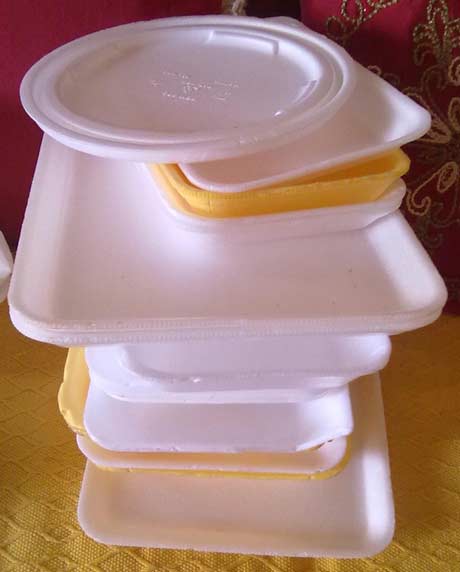
Good morning!! I have a lot of Styrofoam food trays to dispose of... can anyone tell me where I can do this???
After processing the Styrofoam, who are the buyers of these balls for industrialization?
Where can I purchase equipment for such purposes?
I am a teacher and in my city every year there are scientific projects, where children research ways and solutions for some product with social relevance. I have been looking for two years for a way to work with Styrofoam and its recycling to help the environment, considering that the city's recycling plant has an end for Styrofoam. Therefore, I would like more information on how to use it without machines or if we collect it, can we send it to the recycling plant?